Buy Cabernet Sauvignon Online — Delivered to the UK
Vinissimus stocks 113 Cabernet Sauvignon wines from the world's best regions — Bordeaux, Napa Valley, Tuscany and Chile. From approachable everyday bottles under £20 to aged Médoc and iconic Napa labels, with delivery across the UK and £10 off your first order.






Buy Cabernet Sauvignon Online — Delivered to the UK
Vinissimus stocks 113 Cabernet Sauvignon wines from the world's best regions — Bordeaux, Napa Valley, Tuscany and Chile. From approachable everyday bottles under £20 to aged Médoc and iconic Napa labels, with delivery across the UK and £10 off your first order.
What does Cabernet Sauvignon taste like?
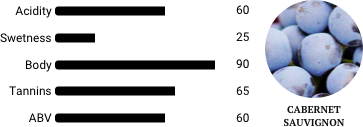
Cabernet Sauvignon produces full-bodied, tannic reds with a consistent character across all origins. Core flavours: blackcurrant, blackberry, cedar and tobacco. With oak ageing: vanilla, mocha and leather. In warmer climates the fruit becomes riper and more generous — think ripe plum and dark chocolate in Napa or Chilean bottles. In cooler areas like Bordeaux or Coonawarra, the structure and acidity are more pronounced, with more restrained fruit and a firmer, longer-lived tannic backbone.
Tannins are firm and structured, acidity is medium-high and alcohol typically ranges from 13.5% to 15%. Most bottles benefit from decanting for 30–60 minutes before serving at 16–18°C.
Cabernet Sauvignon in Bordeaux
Cabernet Sauvignon rules the Left Bank of Bordeaux — Pauillac, Saint-Estèphe, Saint-Julien and Margaux. Though the variety's character shines through across all four appellations, styles differ: Margaux wines are finer and more perfumed, while Saint-Estèphe tends to be more structured and vigorous. Young wines show a deep violet colour that moves towards garnet over the years. Typical aromas of cedar and pencil lead develop with oak ageing, alongside dark fruit — plum and black cherry. The best Left Bank bottles can evolve for decades.
Cabernet Sauvignon in Italy — the Super Tuscans
In Italy, Cabernet Sauvignon has been central to the Super Tuscan revolution — wines produced outside the traditional appellation rules, often blending Cabernet with Sangiovese for added structure and international appeal. The Bolgheri coast is the heartland, where mineral clay soils and a Mediterranean climate produce particularly structured and elegant Cabernet. Further inland across Maremma and Chianti, limestone and marl give a more dynamic character with exceptional longevity. Sassicaia, Ornellaia and Tignanello are the benchmarks.
Cabernet Sauvignon in the New World
Australia and California are its two most successful New World destinations. In Napa Valley, Cabernet Sauvignon produces some of the most powerful and concentrated wines in the world — riper and more generous than Bordeaux, with more obvious oak and higher alcohol. In Coonawarra, Australia, terra rossa soils produce a more restrained, elegant style with a distinctive mint and eucalyptus character. Chile's Maipo Valley produces reliable, fruit-forward Cabernet at competitive prices — one of the best value sources for the grape globally.
Cabernet Sauvignon and food
The tannins and structure of Cabernet Sauvignon make it a natural match for red meat and dishes with fat and protein:
- Grilled ribeye or sirloin steak — the classic pairing
- Slow-braised lamb shoulder or beef short ribs
- Roast lamb with rosemary and garlic
- Aged hard cheeses — mature Cheddar, Manchego, Parmigiano
- Dark chocolate (70%+ cocoa) as an after-dinner pairing
Avoid delicate dishes — the tannins will overpower fish, chicken or anything without enough weight to match.
FAQ
Is Cabernet Sauvignon a dry wine?
Yes. Almost all Cabernet Sauvignon is dry — residual sugar is fermented out completely. Any perceived sweetness comes from ripe fruit character and oak ageing, not actual sugar in the wine.
Is Cabernet Sauvignon red or white?
Red. Cabernet Sauvignon is a dark-skinned grape producing full-bodied red wine. There is no white version.
What is the difference between Cabernet Sauvignon and Merlot?
Both are Bordeaux grapes but with distinct characters. Cabernet has firmer tannins, more blackcurrant and cedar, and generally needs longer to open. Merlot is softer, rounder and more approachable young, with plum and chocolate notes. If Cabernet feels too tannic, Merlot is the natural step.
How long does Cabernet Sauvignon last?
Entry-level bottles are best within 3–5 years of the vintage. Mid-range Bordeaux and Napa Cabernet age well for 10–15 years. The best bottles from top producers can develop for 20–30 years.
What is a good Cabernet Sauvignon for beginners?
Chilean Cabernet is the most accessible entry point — ripe, fruit-forward and well priced. Spanish Cabernet blends from Penedès and Somontano are another reliable starting point at under £20.