

Buying Wine Smartly: What Makes a Bottle Worth Drinking or Investing In
Learn how to choose between wine for drinking and wine for investing. Understand ageing potential, storage needs and key differences for wine buyers.

In the United Kingdom, wine often becomes more than just a drink. It accompanies weekends, dinners, quiet evenings at home, and sometimes even turns into a small promise for the future.
One day, you look for a bottle to pair with dinner, and the next, you catch yourself wondering whether it is worth starting a small collection that could appreciate over time. From here comes a simple question: should you buy wine to drink now, or choose it with investment in mind?
Wine to drink today
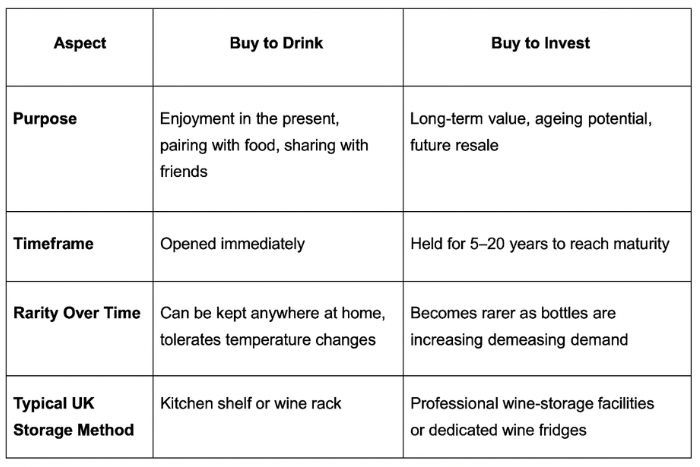
Wines meant for immediate enjoyment are all about flavour, simplicity and ease. They are ready the moment you open them and do not require ageing. Typical options include young, fruity reds from Spain or Italy, light whites such as Albariño or Pinot Grigio, or fresh sparkling wines suitable for any casual occasion.
In UK shops, they usually cost £9–20, and they are designed for moments, not for long-term plans.
These bottles are forgiving when it comes to storage. A kitchen shelf is perfectly fine, because the wine has already reached its ideal drinking stage. There is no need for special equipment or strict conditions. You simply open the bottle and enjoy what it has to offer.

Wine purchased as an investment
Investment wine is chosen with a very different intention. Buyers look ahead, sometimes ten or twenty years into the future. These wines come from regions that have shown consistent quality over decades, such as Bordeaux, Burgundy, Champagne, Barolo and Brunello di Montalcino.
They mature slowly, they gain complexity with time, and their limited availability often leads to rising value.
Most investment-worthy bottles start at around £30–40. While this is far from an exclusive hobby, it does require attention and discipline. You need to follow vintage reports, understand which producers have strong reputations, and be aware of how production volume affects scarcity and price.
Because these wines develop slowly and are sensitive to temperature swings, they should not be kept in a warm or humid flat. Many UK collectors use professional wine-storage facilities or dedicated wine fridges. These options help maintain value and prevent damage caused by unstable conditions.
Key differences between the two buying approaches
Common mistakes beginners make
Many newcomers buy bottles purely for their attractive labels, not realising that only certain regions have a long track record of appreciating wines. Others store investment bottles at home, where heat from radiators or shifts in humidity can easily spoil them.
Another issue is choosing wines produced in very large quantities. When supply is high, price growth is unlikely. And of course, impatience is a classic problem—opening a wine years before it reaches maturity simply because you want to taste it. It happens to everyone.
£10
Special offer available for a minimum purchase of £99. Discount voucher valid for four weeks from issue date. Cannot be used in conjunction with other promotions except for the free delivery special offer.
When is the right time to sell?
Investment wine should be sold when it approaches peak maturity. This becomes clearer through critics’ evaluations and price movements at auctions. If prices begin rising faster than usual, the wine may be at or near its prime.
The UK has several reliable platforms that make selling straightforward, without complicated conditions or lengthy procedures.
Can both approaches be combined?
Many people enjoy combining everyday drinking with long-term collecting. A common strategy is buying several bottles of the same wine: one for now, one for the next few years, and one for long-term ageing. This allows you to enjoy the wine through its evolution while also building a meaningful small collection.
A human detail
If you buy wine as an investment, it is often wise to buy two bottles instead of one. One goes into long-term storage, and the other remains available for you to open when curiosity strikes. It is a practical way to avoid disappointment when the time to sell finally arrives.
Final thought
Wine can bring people together in the moment, but it can also create value over time. One path leads to a relaxed evening; the other leads to a story shaped by patience. Both choices are equally valid. You may reach for a fresh Albariño today, and tomorrow consider your first serious Barolo to keep for the future.